



First-Time Progressive Lenses in Kenya: What to Expect in the First Week
So your optician just told you it’s time for progressive lenses. Maybe you’re in your early 40s and you’ve started holding your phone at arm’s length to read your WhatsApp messages. Maybe menus at restaurants have started looking suspiciously blurry. Or maybe you’ve been squinting at your laptop screen and telling yourself it’s just the lighting.
Whatever brought you here, welcome — you’re in good company. Presbyopia, the age-related change that makes near vision blurry, affects the vast majority of adults over 40. It’s not a disease. It’s not a sign something is wrong. It’s simply your eye’s natural lens gradually losing flexibility, the same way joints get a little stiffer over time. And progressive lenses are one of the best solutions available — a single pair of glasses that handles distance, intermediate (think: your computer screen), and near vision all at once.
But here’s what nobody tells you before you pick up your first pair: the first week can feel a little strange. And if you’re not prepared for that, it’s easy to panic, put them back in the case, and wonder if you made the wrong choice.
You didn’t. This guide will walk you through exactly what to expect — day by day, symptom by symptom — so you can adapt confidently and enjoy the full benefit of your new lenses.
First, Let’s Understand What You’re Actually Wearing
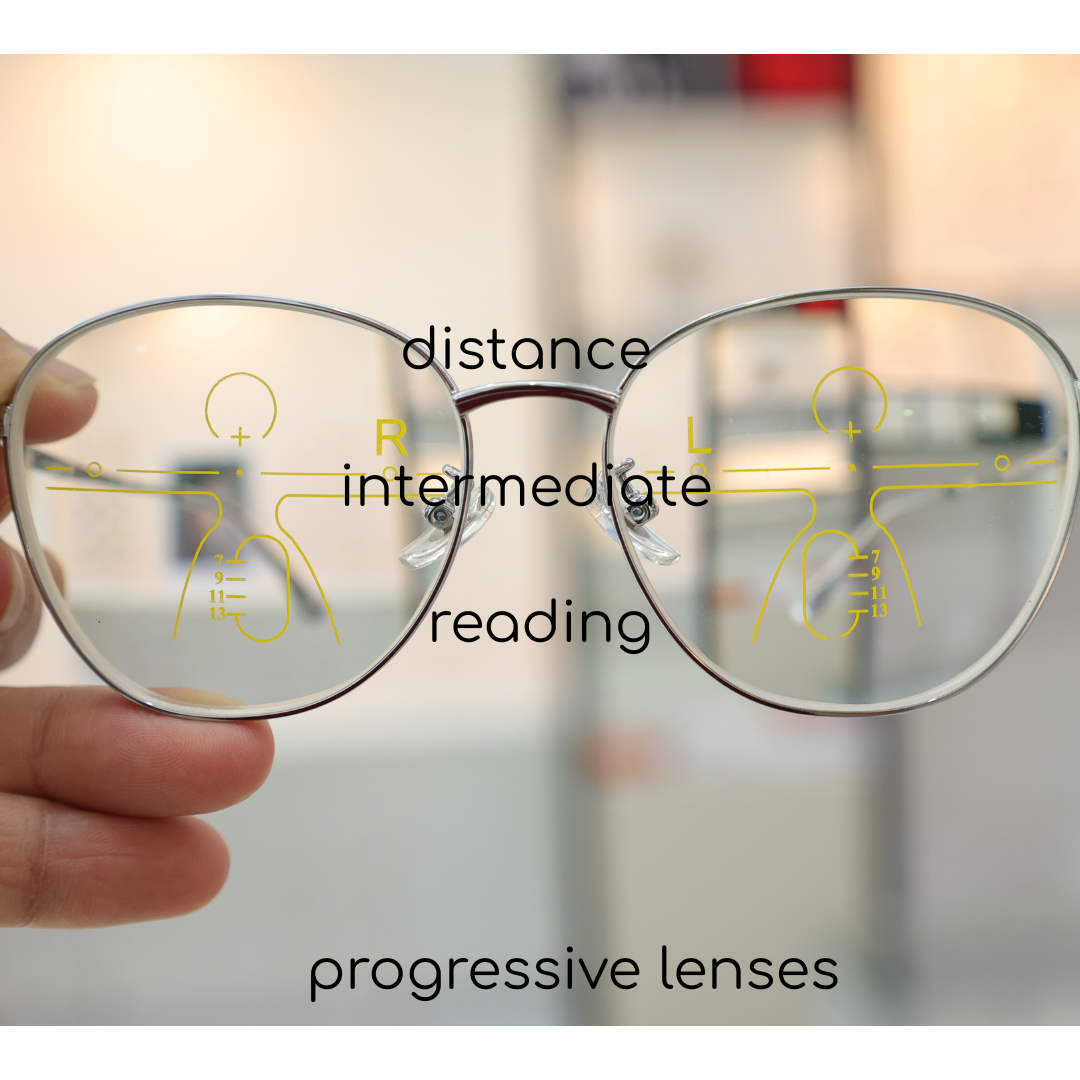
Progressive lenses are essentially three prescriptions blended into one lens, with no visible dividing lines. Unlike old-school bifocals that have that obvious line running across the middle, progressives offer a smooth, seamless gradient:
- Top of the lens: Your distance prescription — for driving, watching TV, looking across the room.
- Middle of the lens: The intermediate zone — perfect for your computer screen, a shop shelf, or the dashboard of your car.
- Bottom of the lens: Your reading prescription — for your phone, a book, a menu, or anything close-up.
The magic happens in the gradual transition between these zones. Your brain has to learn which part of the lens to use for each task — and that’s exactly what the first week is all about. Think of it less like wearing new glasses and more like learning a new skill. A bit of effort upfront, then it becomes completely automatic.
Day 1–2: The Honest Truth
Let’s be real. The first day with progressive lenses is rarely “wow, this is amazing.” For most first-timers, it’s more like: why does the floor look slightly closer than it should?
Here’s what’s completely normal to experience in the first couple of days:
- A mild “swimming” or swaying sensation — especially when you turn your head quickly. The edges of progressive lenses have some natural distortion built into the design. This is unavoidable, and it fades as your brain adapts.
- Peripheral blurriness — when you glance to the sides with your eyes (rather than turning your head), things may look soft or off. That’s because the sharp vision zone runs down the centre of the lens, not the edges.
- Mild dizziness or feeling off-balance — especially on stairs or uneven ground. Totally normal.
- The floor looking slightly closer or the ground seeming to curve — your depth perception is recalibrating. This usually settles by day three or four.
Pro Tip for Day 1
Wear them indoors in a familiar environment. Practice reading a book, watching TV, walking around your home. Keep them on for at least 2–3 hours. Resist the urge to go back to your old glasses — that’s the one thing that will slow your adaptation most.
The Single Most Important Habit to Build
“Point your nose at whatever you want to see.”
With your old single-vision glasses, you probably moved your eyes freely in all directions. With progressives, you need to move your whole head so that your nose points toward your target. This ensures you’re looking through the correct zone of the lens.
A practical example: you’re reading a message on your phone, and you glance up to check the TV. If you only move your eyes upward, you’ll still be looking through the near vision zone at the bottom of the lens — and the TV will look blurry. Instead, lift your chin and turn your head toward the screen. Instantly clear.